
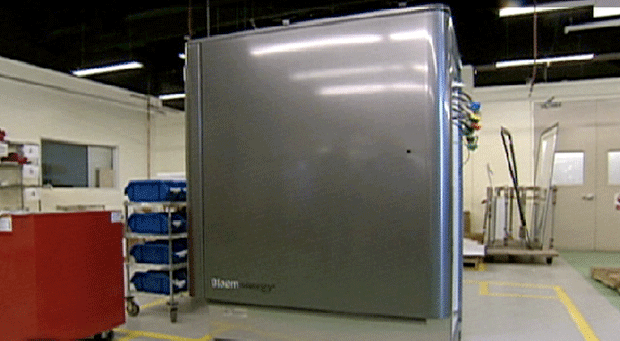
The world of energy and entrepreneurship is crackling with electric anticipation this week after an Indiaborn scientist-CEO provided a sneak peek over the weekend of a clean and efficient model of power generation in a box,which can eliminate the traditional grid and challenge monopolies.
Supporters are claiming that KR Sridhars Bloom box,scheduled for a big-splash unveiling in Silicon Valley on Wednesday,could be the holy grail of the worlds energy quest,but even sceptics agree that it is a unique power plant-in-a-box.What acres of power grid can generate,Sridhars Bloom Box can crank out in a fraction of the footprint in a squeaky clean manner too.
It is already being done on the campuses of Google and eBay among others.FedEx,Wal-Mart and Staples are among a score of Fortune 100 companies that have signed up as clients.The former US secretary of state,Colin Powell,among those who endorse the technology,is on the board of directors of Sridhars Bloom Energy,an eight-year-old stealth start-up,which raised more than $400 million from Silicon Valleys venture capitalists at a time the regions economy was in a tailspin.
The man at the centre of all the excitement is Dr KR Sridhar,49,who,prior to founding Bloom Energy,was a professor of aerospace and mechanical engineering as well as director of the Space Technologies Laboratory (STL) at the University of Arizona.He is also,literally,a rocket scientist,having served as an advisor to the National Aeronautics and Space Administration in the areas of nanotechnology and planetary missions.
Dr Sridhar received his bachelors degree in mechanical engineering from the University of Madras and moved in the 1980s to the US,where he earned an MS in nuclear engineering and PhD in mechanical engineering from the University of Illinois,Urbana-Champaign,home to such start-ups as Netscape.
At its heart,Sridhars Bloom Box claims to be a game-changing fuel cell device that consists of a stack of ceramic disks coated with secret green and black inks.
Watt An Idea!
Dr Sridhars (in pic) Bloom Box consists of ceramic disks,coated with green & black inks Hydrocarbons,such as natural gas,are stored in an adjacent tank & pumped into the Bloom Box to produce clean,abundant electricity The power plant-in-a-box can produce one kilowatt of electricity Bloom Box for homes could be out in 5-10 years for as little as $3,00.
Article from The Times of India dated 23 February 2010
Comments
Post a Comment